Why two brake quotes for the same car look nothing alike
Brake repair is one of those jobs where two workshops can look at the same car and give you numbers that are hundreds of dollars apart, and both can be quoting honestly. The gap almost always comes down to scope. One quote covers pads only. The other includes discs, or fluid, or a seized caliper that the first workshop never checked for.
So the useful question is not what brake repair costs in general. It is what your car needs right now. Before we put a number on anything we take the wheels off, measure pad thickness and disc thickness, and check whether the calipers are moving freely. That inspection is what separates a quote from a guess, and guesses are the expensive kind.
Pads, discs and fluid: what each one actually costs
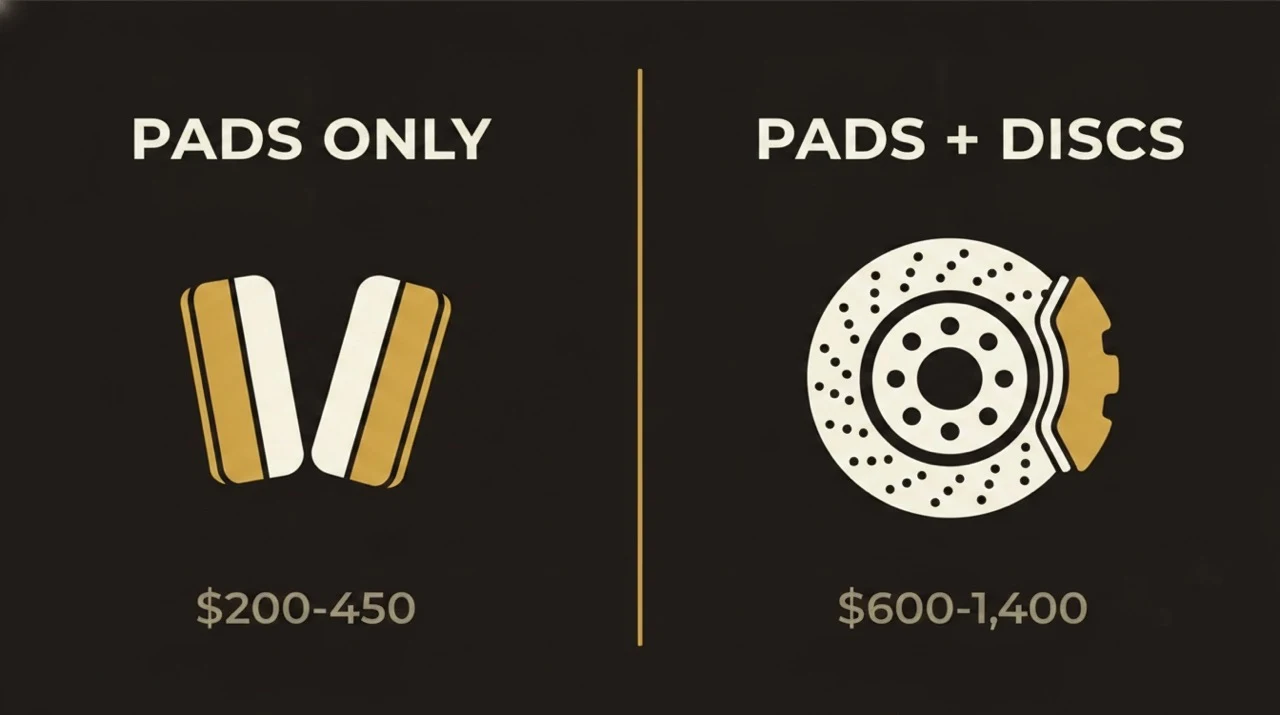
Here is an honest ballpark for Singapore, with the reminder that your car decides the final figure. Front brake pads on a common Japanese or Korean daily driver typically land around 200 to 450 dollars per axle including labour. Continental models with bigger calipers, wear sensors, or an electronic parking brake usually sit in the 400 to 800 dollar range per axle.
Once discs come into it, the job roughly doubles. Pads and discs together commonly run 600 to 1,400 dollars per axle depending on rotor size and whether the parts are OEM or a reputable aftermarket equivalent. Brake fluid is the cheap one that people skip, usually 80 to 180 dollars for a full flush and bleed. Rear jobs are often a little less than fronts, because the front brakes do most of the work and wear faster.
Those bands assume a straightforward job. A seized caliper, a snapped bleed nipple, or a rusted-on rotor adds labour, and we will tell you before we start rather than after.
When discs genuinely need replacing, and when they do not
This is where most of the trust in a brake quote is won or lost. Every brake disc has a minimum thickness figure, usually stamped on the disc itself or in the manufacturer data. New discs might start at 25mm and be scrapped at 22mm. We measure with a micrometer at several points rather than eyeballing it, because uneven wear is common and one measurement can flatter a disc that is actually finished.
Thickness is not the only test. We also look for deep scoring, a pronounced lip at the outer edge, heat cracking, and whether the surface has blued from overheating. A disc can be within thickness spec and still need replacing if the surface is badly grooved, because new pads will not bed properly against it.
But plenty of cars genuinely go through two sets of pads on one set of discs. If your discs measure fine and look healthy, we will say so and you pay for pads only. If a workshop tells you discs must always be replaced with pads, ask them for the measurement.
The quote that costs you twice: sticking calipers
The single most common thing we end up undoing is a car that got four new pads when one caliper was sticking. Pads are the cheap part and the easy sell. Finding out why the pads wore unevenly is the part that actually saves you money.
If your car pulls to one side under braking, or one wheel is noticeably hotter or dustier than its partner after a drive, that is usually a caliper or slide pin problem rather than a pad problem. Fit new pads without freeing up that caliper and the new pads wear out at the same crooked angle, often within months. You pay twice for the same job.
It is the same logic we apply on the brake and suspension repair side generally. Replace the worn part, but find out what made it wear first.
What pushes a brake bill up
Car choice does most of the work. Bigger and heavier cars need larger rotors and more material, and continental models frequently add brake wear sensors that have to be replaced alongside the pads. An electronic parking brake has to be retracted with a scan tool rather than wound back by hand, which is straightforward but adds labour time.
Parts choice matters too, and the honest answer is that both OEM and reputable aftermarket can be correct. OEM or OE-equivalent suits a car you plan to keep for years. A good aftermarket brand can deliver similar quality for less. The trap is the cheapest unbranded pad, which often dusts heavily, fades when hot, and wears the disc faster, so it costs more across the life of the car.
Driving pattern is the quiet factor. Stop-start expressway traffic and a heavy right foot will finish a set of pads far sooner than steady suburban driving, which is why mileage alone is a poor guide to when yours are due.
How we approach brake work at JW Motoring
We inspect before we quote, every time. Wheels off, pad and disc thickness measured, calipers and slide pins checked for free movement, and a look at the fluid condition while we are in there. You get told what is worn now, what is close, and what is still fine. If something can safely wait a few months, we would rather say so than bundle it in.
Brakes are also a system we keep learning about rather than assuming we know. Our team attended Brembo technical training on braking technology and system checks, which keeps our inspection and fitment approach current for the everyday repair work that fills our bay. Most of that work is ordinary pads and discs, not exotic hardware.
If you are hearing a squeal, feeling a pulse through the pedal, or just want to know how much life is left before your next long drive, send us your car model and what you are noticing. We will tell you what to check first, and we would rather talk you out of an unnecessary job than sell you one. You can see our approach on the car repair page, or read the companion guide on brake and suspension warning signs if you are still working out what your car is telling you.