
What actually makes up your car's suspension
Suspension is not one part, which is why a single repair cost figure never tells the whole story. Your car rides on shock absorbers or struts that damp the bounce, springs that carry the weight, control arms that locate the wheels, ball joints and bushings that allow controlled movement, and stabiliser bars and links that keep the body flat in corners. Each wears at its own pace and carries its own price.
When someone asks what suspension repair costs, the honest first answer is a question: which part is worn? A tired bushing, a leaking shock, a knocking control arm, and a sagging spring are different jobs with different parts and labour. A workshop that quotes a big number before identifying the worn component is guessing, and guesses are usually expensive.
Signs of suspension wear most drivers ignore
Most suspension problems arrive quietly. The car starts to float over undulations, dives more under braking, or leans further in corners than it used to. You might hear a soft clunk over speed humps, feel a vibration that tyre balancing does not fix, or notice the steering wandering slightly on the expressway. Because the change is gradual, many owners adapt to it without realising the car is getting less safe.
Tyres often tell the story first. Cupped or uneven wear, a steering wheel that no longer self-centres, or a car that pulls to one side can all point to worn suspension or alignment that has drifted because something underneath has loosened. If you have read our companion guide on brake and suspension warning signs, the same rule applies here: the cheap moment to fix suspension is before it damages tyres, alignment, and other components.
Cost breakdown: shocks, struts, control arms, bushings
Here is an honest ballpark for Singapore, with the firm reminder that your car decides the final figure. Bushings and stabiliser links are usually the most affordable jobs, often in the low hundreds per item including labour, though pressing certain bushings is labour-intensive. Shock absorbers and struts are typically replaced per axle as a pair, and can range from roughly 400 dollars on a common Japanese car to well over 1,500 dollars on a continental model with complex or electronic struts.
Control arms sit at the higher end because on many cars they come as a full assembly with ball joints and bushings built in, and because reaching them takes time. Coil springs, ball joints, and top mounts add to the bill when they are worn alongside the main part. After most suspension work the car needs a wheel alignment, usually in the region of 60 to 120 dollars, which is not an upsell but a necessary final step so the new parts wear evenly.
Why continental cars cost more for suspension work
If you drive a BMW, Mercedes, Audi, or similar, expect suspension work to cost more than the same job on a mass-market Japanese car, and not because anyone is marking you up unfairly. Continental cars often use multi-link setups with more individual arms, struts that integrate the spring and damper, electronically adjustable dampers, and parts that are simply more expensive to buy. More components and tighter assembly mean more labour hours too.
The upside is that the work is predictable when a workshop knows the platform. A good independent can source quality OE-equivalent parts, plan the job properly, and still come in below dealer labour rates. The key is honesty about scope: a complex strut job on a continental car is a bigger task than a simple shock swap, and the quote should reflect that clearly rather than hide it.
OEM vs aftermarket parts: the real trade-off
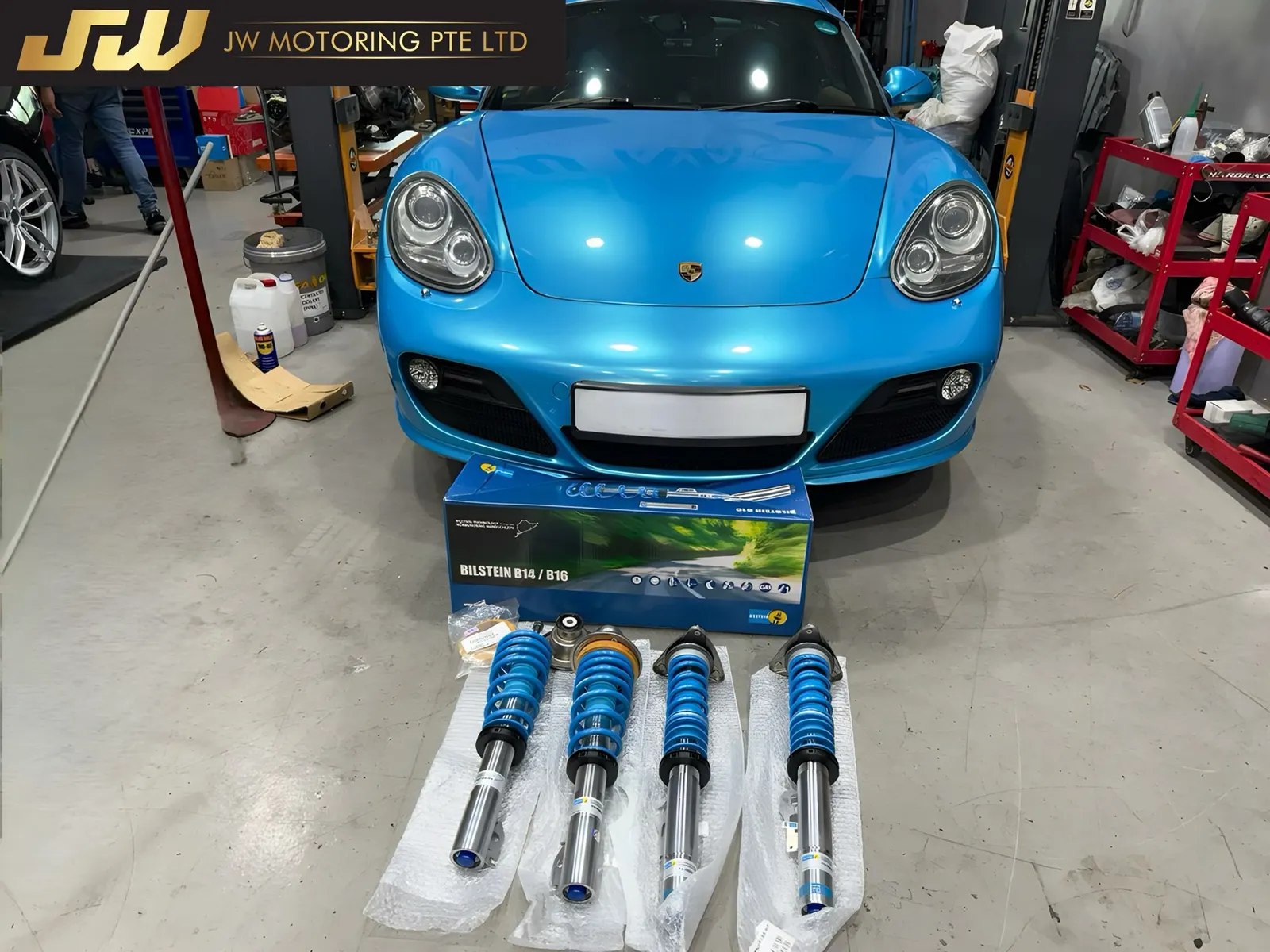
The parts decision changes the bill more than most owners expect. OEM or OE-equivalent components match the original ride quality and durability, and make sense for a car you plan to keep for years. Reputable aftermarket brands can deliver similar quality, and sometimes a better ride, at a friendlier price. For owners chasing a sportier feel, a quality coilover or performance damper is a different conversation again, and one we are happy to have when an upgrade is the real goal rather than a repair.
The genuine trap is the bottom-of-the-market unbranded part. It looks like a saving on the invoice, but a cheap shock or bushing that wears out in a year means paying for the labour twice. We would rather fit a part once that lasts than have you back in the bay sooner than you should be. Which way we lean depends on your car, your budget, and how long you intend to keep it, and we will lay that choice out plainly.
How we inspect and price suspension at JW Motoring
Our approach to suspension is the same as everything else at our Kaki Bukit workshop: inspect first, explain, then quote before any work starts. We put the car on the lift, check shocks for leaks, test bushings and ball joints for play, look at springs and mounts, and take a short drive when the symptom is something you feel rather than see. Then we tell you what is actually worn, what can wait, and what genuinely needs doing now for safety.
From there you get an itemised quote covering parts, labour, alignment, and any optional items, with the OEM-versus-aftermarket choice spelled out so you can decide. If your suspension complaint turns out to be alignment, a tyre issue, or something unrelated, we will say so rather than sell you parts you do not need. If you have a quote from elsewhere that feels high, send us the details and we will give you an honest second opinion before you commit.


