
What an engine overhaul actually is (and what it isn't)
An engine overhaul is a workshop strip-down of major engine internals to fix wear or damage that a normal service cannot reach. It is not the same as routine servicing, a top-up, or replacing a single sensor. Overhaul work means the engine comes apart, parts are inspected, worn components are replaced, and the engine is rebuilt to a spec that should give you another 100,000 to 200,000 km of life.
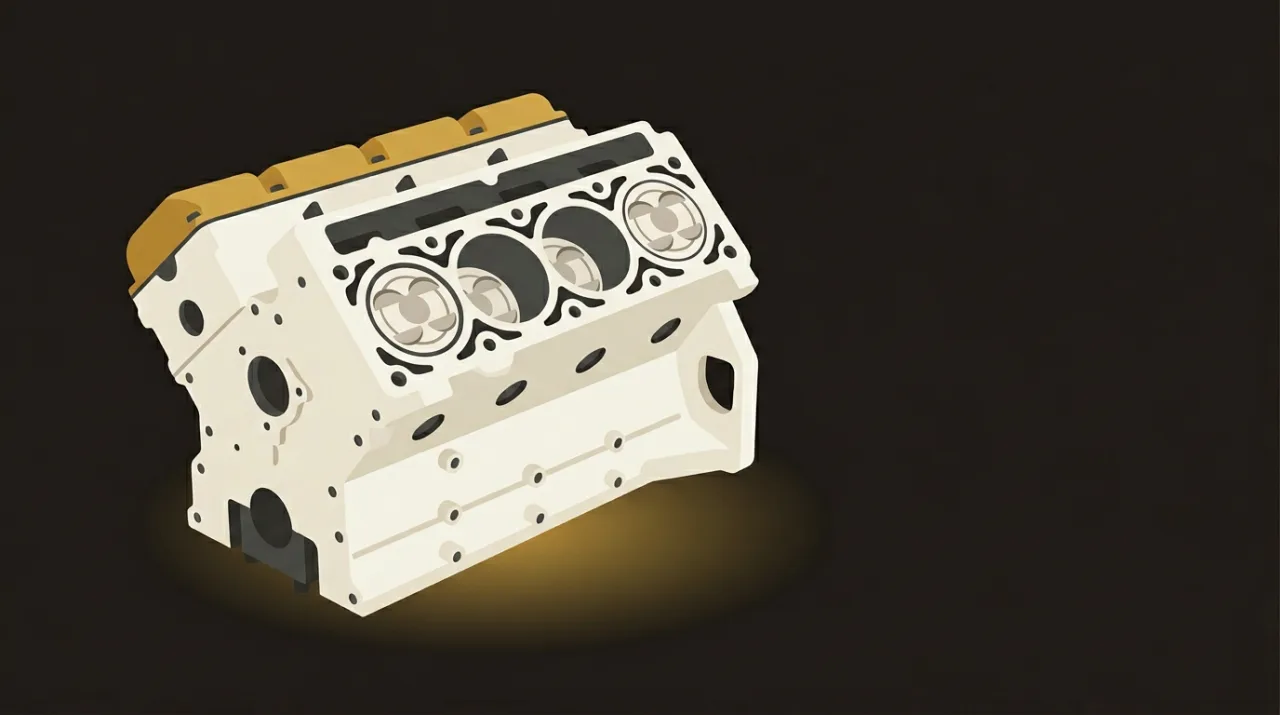
There are two practical scopes. A top-end overhaul focuses on the cylinder head: head gasket, valve stem seals, valves, valve guides, sometimes camshaft and timing components. A full overhaul goes further down into the bottom end: piston rings, main and rod bearings, cylinder rework or honing, oil pump, and seals throughout. Top-end work fixes oil burning, head gasket failure, and valve sealing issues. Full overhauls are needed when bottom-end wear shows up as low compression, knocking, or excessive blow-by.
When does an engine actually need an overhaul
Engines do not need overhauls on a schedule. They need them when wear or damage crosses a threshold that a normal service cannot fix. Common triggers we see at the workshop include persistent oil consumption (more than 1L per 1000 km without leaks), blue smoke on start-up or under load, loss of compression confirmed with a compression test, coolant in the oil or oil in the coolant, and knocking or rod-bearing noise from the bottom end.
A car that simply feels old or has high mileage does not need an overhaul. A 200,000 km Toyota that still pulls cleanly, holds compression, and does not drink oil is fine. Overhauls are triggered by symptoms, not odometer milestones.
Engine overhaul cost in Singapore by car type
Pricing varies enormously because the parts cost gap between a Japanese 1.5L and a Continental 2.0L turbo is large, and labour hours scale with how much has to come out of the engine bay.
Japanese and Korean naturally-aspirated engines typically run $1,800 to $3,000 for a top-end overhaul and $3,500 to $5,500 for a full overhaul. Continental NA engines run $2,500 to $4,000 top-end and $5,000 to $7,500 full because parts cost more and access is tighter. Turbocharged petrol engines push top-end work to $3,000 to $4,500 and full overhauls to $6,000 to $9,500. Diesel engines are the most expensive, with full overhauls regularly between $7,000 and $12,000+.
If a workshop quote sits well below these ranges, ask exactly which parts are being replaced and which are being reused. Cheap overhaul quotes almost always reuse worn bearings, skip the cylinder rework, or use generic gaskets that fail within 12 months.
Overhaul vs engine replacement: the real maths
Replacing the engine entirely is sometimes cheaper than rebuilding the existing one. A used recon engine (half-cut import from Japan, 60,000 to 100,000 km) costs $2,000 to $5,000 fitted for most Japanese cars. A reconditioned engine (workshop-rebuilt to known specs, with a 6-12 month warranty) costs $4,000 to $8,000 fitted. A new OEM engine is $8,000 to $20,000+.
Our rule of thumb: if your full overhaul quote is more than 70% of a quality reconditioned engine, a swap usually wins on warranty and downtime. If it is below 50%, overhaul almost always wins because you keep your engine's known history.
What pushes engine overhaul cost up
Five things commonly push a quote past the headline range: cylinder rework if bores are scored or out of round (adds $400 to $1200), cylinder head damage requiring skimming or full replacement (Continental heads can be $2000+), timing system replacement while the engine is apart (adds $400 to $1500), preventive replacement of water pump, thermostat, oil pump, alternator and starter ($500 to $1500 stack), and turbo refresh or replacement on turbocharged engines ($1500 to $4500).
A quote that does not break these out separately is hiding either margin or shortcuts.
How we approach engine overhauls at JW Motoring
We do not start with a quote. We start with a diagnostic: compression test, leak-down test, oil analysis, and a visual inspection. About a third of the cars sent to us for an overhaul turn out to need something simpler, like a fuel system clean or a sensor replacement.
When an overhaul is the right call, we quote in writing with all parts itemised, separate top-end versus full-overhaul scopes if the inspection is still pending, and offer a clear go-or-no-go decision point after the head is off. We use OEM gaskets and seals for everything that touches combustion or oil pressure, and we do not reuse rod or main bearings on a full overhaul.


