
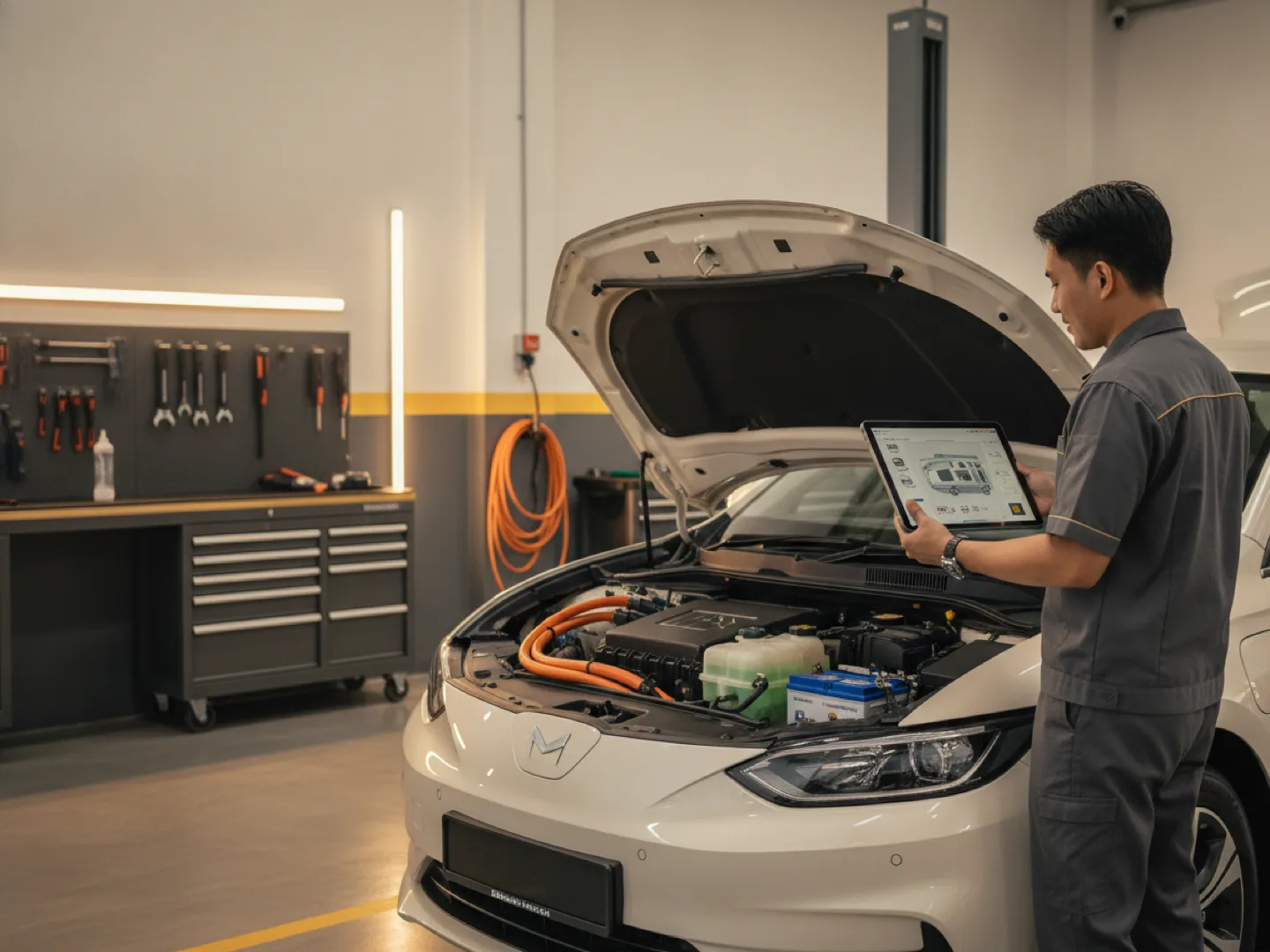
The 'maintenance-free' myth: what an EV actually skips
The showroom line that an electric car needs almost no servicing is one of the most persistent myths we hear in the bay. It is half true, and that half is what gets owners into trouble. An EV genuinely skips the jobs tied to a combustion engine: no engine oil and filter, no spark plugs, no timing belt, no exhaust or fuel system to fret over. For many owners that removes the most frequent workshop visits, and that part is real.
The trouble starts when 'fewer engine jobs' gets rounded up to 'nothing to service'. An EV still carries a coolant system that keeps the battery and power electronics at a safe temperature, brakes that need fluid and inspection, four tyres that wear faster because the car is heavy, a cabin air filter, and a small 12V battery that wakes up the whole vehicle. Hybrids add a full petrol engine on top of all that. Skipping the basics does not delete the wear, it just hides it until something more expensive gives way.
What still wears out in Singapore's heat
Our climate is hard on the exact systems electrified cars depend on. Thermal management is the big one: coolant protects the high-voltage battery and the inverter, and coolant, pumps, and hoses age like any other part. When that circuit is neglected in tropical heat, you risk battery derating and, in the worst cases, damage to components that cost far more than a scheduled coolant service ever would.
Brakes are the surprise for many EV owners. Regenerative braking slows the car using the motor, so the friction pads see less use, which sounds like good news. In practice the discs and calipers can seize, glaze, or corrode from underuse and humidity, and brake fluid still absorbs moisture over time and needs replacing on schedule. Add faster tyre wear from the weight, a cabin filter that clogs in our dust and humidity, and a 12V battery that quietly ages, and the 'nothing to service' picture falls apart quickly.
Battery health: the part owners worry about most
There are really two batteries to think about. The one that makes headlines is the large high-voltage pack that drives the car. It loses a little capacity every year, which you notice as shorter range, and heat accelerates that decline. No workshop can reverse normal ageing, but the pack lasts far better when its cooling system is healthy, when you avoid leaving it at full charge in the sun, and when faults are caught early through diagnostics rather than ignored until a warning light appears.
The quieter one is the humble 12V auxiliary battery. Even a pure EV needs it to boot up its computers, unlock, and close the high-voltage contactors, and when it dies the car can refuse to start even with a full main pack. It ages the same way any battery does in our heat, and it is a routine replacement item, not a drama. If you want the deeper picture on how batteries fail and what fair replacement looks like, our car battery replacement guide walks through the warning signs in detail.
Hybrids: you are looking after two powertrains
A hybrid is not a simpler EV. It is a car with two powertrains, and both need looking after. The electric side wants the same thermal, brake, and 12V attention as any EV. The petrol side still needs genuine engine servicing, just spread over slightly longer intervals because the engine runs less of the time. The single most common mistake we see is treating a hybrid like a normal petrol car at oil change time.
Modern hybrid engines run tight tolerances and a specific thin oil, often SAE 0W-16, chosen for rapid cold-start protection, lower friction for economy, and a smoother handover between engine and motor. Fitting a thicker generic grade because it is on the shelf risks slow lubrication on cold starts and a rougher drive. On a recent hybrid in our bay we serviced to the maker's 0W-16 spec using an oil formulated for hybrid duty, because matching the grade to the specification is not a detail, it is the job.
High-voltage work has honest boundaries
High-voltage systems are not something to improvise around. At JW Motoring our qualified technicians carry out the high-voltage diagnostics and repairs our facility is equipped and authorised for, and we maintain everything surrounding the pack: the coolant circuit, the brakes, the 12V system, tyres, and chassis. That covers the large majority of what an EV or hybrid actually needs over its life.
Where we draw a firm line is on jobs that need OEM security access, sealed enclosure work, or a full high-voltage pack replacement that sits outside our licence. Rather than guess our way through something that carries real safety and warranty consequences, we document what we find and point you to the right dealer or specialist. We would rather be straight about that than take on a job we should not. You should be wary of any workshop that claims it can do everything on every EV without mentioning where the boundaries are.
How we service EVs and hybrids at JW Motoring
Our approach mirrors how we handle every car at our Kaki Bukit workshop: understand how you use the car, inspect properly, then explain before we touch anything. For an electrified car that means checking the cooling and coolant circuit where accessible, the brakes and brake fluid, tyres and alignment, the cabin filter, the 12V battery health, and running high-voltage-safe diagnostics within our tooling. On hybrids we add the engine service to the correct oil spec. You get a plain summary of what is healthy, what we are watching, and anything that genuinely needs doing now.
We have carried this out on everything from mainstream hybrids to late-model EVs like the Xpeng G6, and the discipline stays the same regardless of badge. If your car is due, if a warning has appeared, or if you simply want an honest baseline check before the next long stretch of heat, our electric vehicle and hybrid maintenance service page explains what we cover, and you are welcome to send us your car's details for a straight answer on what it needs.


